I build consumer products and the systems that build them.
I currently lead Wallet, Base App, and Applied AI Engineering at Coinbase. Previously Uber and Qualcomm.
Most recently I've been focused on AI-native engineering - where agents own work and engineers design the systems around them.
Husband, father, lover of wine, pizza, and bikes (human powered).
Coinbase · Uber · Qualcomm
Philosophy
The interface layer between humans and AI is the highest-leverage design problem of our time.
I want to build the systems and surfaces
Every user's first experience with AI happens through the interface layer. Their mental model of what AI can do - whether it's trustworthy, whether it's worth coming back to - is shaped by latency, layout, and the quality of the first response. I've spent 12+ years earning trust at that layer, and I'm focused on building the surfaces that will define the AI era.
Trust Breaks in Milliseconds. I've Spent Years Building For It.
Why the interface layer is where users stick or churn
Trust, once lost, is expensive to rebuild. I know this from building products where a single bad experience doesn't just cost a user; it costs them money, their safety, or their belief that technology is on their side.
At Coinbase, I led the launch of a self-custody wallet and trading app to millions of users. Not just the engineering, but also the trust and safety systems, content moderation policies, and protective UX that kept people safe from pig-butchering scams, phishing, and fraud. I was in the trenches with Legal, T&S, and compliance building policies from scratch because we were first to market and no rulebook existed.
At Uber, I learned that reliability is trust but expressed as uptime. When your system serves every rider and driver on earth, downtime is measured in revenue per second and human frustration per millisecond. You build a culture of operational rigor or you lose users. There's no middle ground.
The interface layer between humans and AI is a trust problem. Latency, layout, and the quality of a first response shape whether someone believes AI can help them or whether they walk away.
This is why the interface layer is the highest-leverage problem in AI right now. Every new user's mental model of what AI can do gets formed in the first 30 seconds. That model determines whether they come back. Whether they trust it with real work. Whether they tell someone else to try it.
I've spent my career at that exact junction: where product quality, safety, and trust are inseparable. At Coinbase, we didn't have the luxury of treating them as separate workstreams. The wallet launch wasn't just an engineering milestone, but a promise: your money is safe, your keys are yours, and we built every surface to make that legible without requiring you to understand cryptography.
That same instinct to build fast, but build responsibly is how I approach every AI product. Not AI for its own sake, but AI that earns the right to be used by making the experience trustworthy from the first interaction.
What "AI-First" Actually Looks Like Inside a 1,000-Person Eng Org
From 0% to 25% agent-authored PRs in 10 weeks
Everyone talks about AI transformation. Very few people have actually done it inside a company with 1,000+ engineers, layered compliance frameworks, and production systems that serve millions of users holding real money.
I have and here's what it looked like.
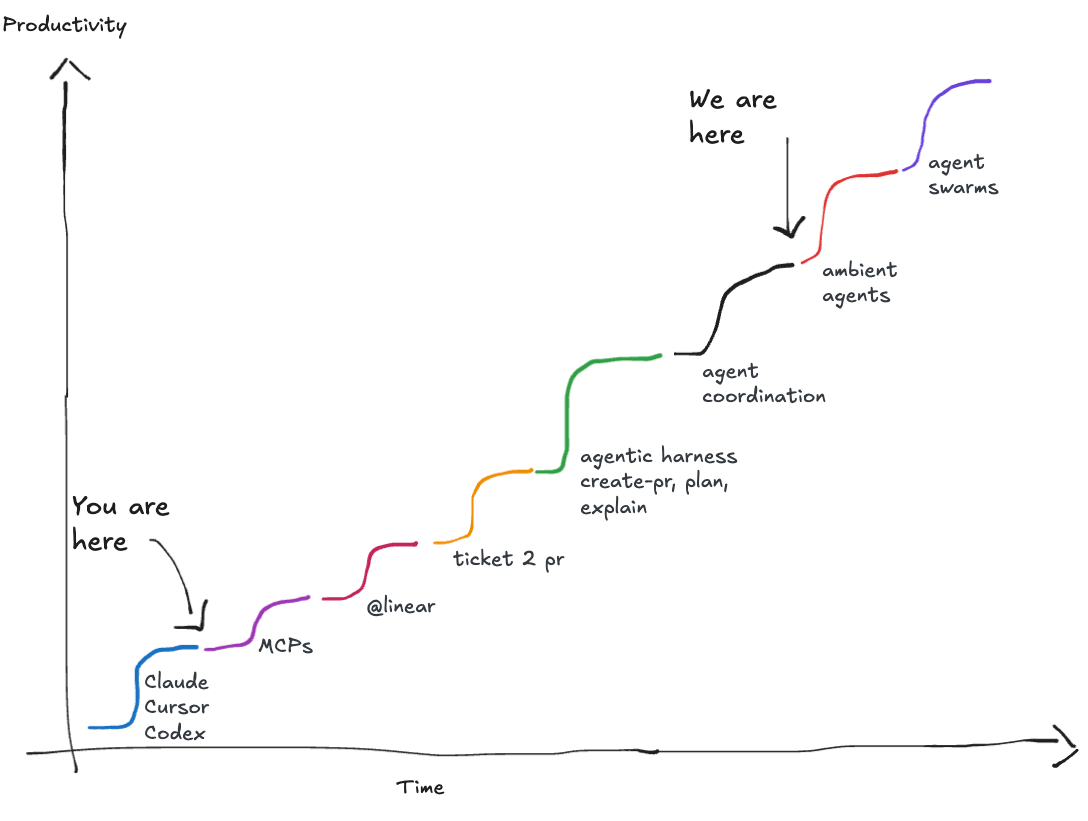
At Coinbase, I led the vision and team to build our in-house agentic harness. We call it Forge. It was an infrastructure bet: build the right primitives, make them good enough that engineers adopt voluntarily, and let the results talk.
25%
Agent-authored PR share, from 0% in 10 weeks
34,000+
Developer hours saved via Forge in Q4
9%+
Of all merged PRs that are fully agent driven
The adoption curve told the real story. Engineers used it because it worked where they worked - in Slack and async. So effective that Brian Armstrong uses it to ship to production - not a demo, but real prod commits. Zero onboarding required.
But adoption inside a high-trust enterprise isn't just about making a good tool. It's about navigating organizational reality. Coinbase doesn't just have security policies; it has sprawling attack surfaces, regulatory obligations across dozens of jurisdictions, and internal processes that evolved over years to protect millions of users and billions of dollars.
When introducing any new system into that environment, it means understanding not just technical integration, but how teams make decisions, where risk tolerance lives, and who owns what guardrail. I've done that work repeatedly by bridging the gap between what a product can do and what an enterprise will actually adopt, given everything we have to protect.
The hardest part of AI transformation isn't the model. It's the organizational immune system. You have to earn trust from security, legal, compliance, and eng leadership simultaneously - and you earn it with results, not decks.
And because of Forge, we saw a burgeoning new class of internal tooling being built too. Mux for parallel agents. Agent Control Plane as a Linear-driven dashboard. CI-Watcher to auto-fix failing PRs. The primitives were right, so the internal ecosystem grew organically.
Ticket-to-production time dropped from ~17 days to 1.8 days. For Coinbase Wallet, we shipped 240+ features and 1,200+ bug fixes across 104 mobile app releases in 2025. We migrated $7B of AUC with zero incidents. We achieved a fundamentally different operating velocity for our enterprise.
The operating philosophy I wrote and am deploying at Coinbase
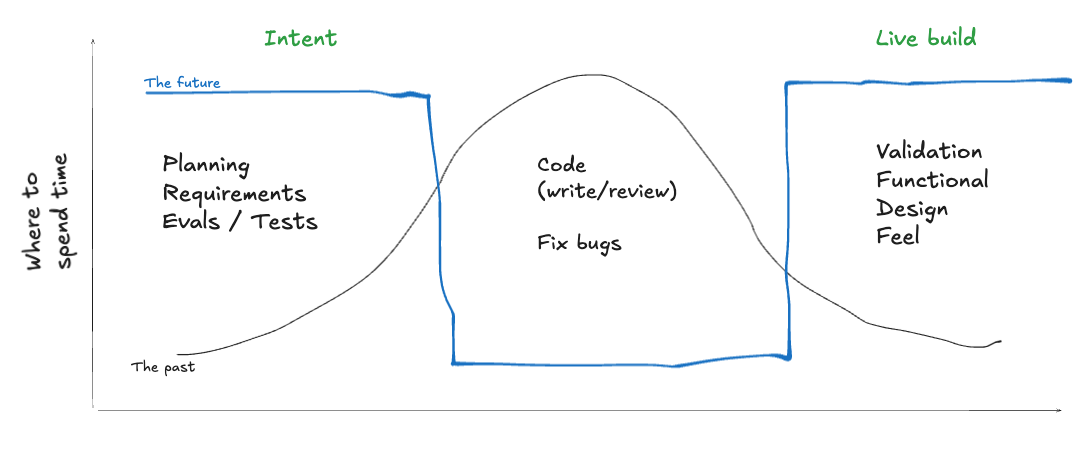
Engineers should not be writing code as the default behavior. Code is no longer the primary medium of execution. Agents are.
This is the operating model I wrote and am deploying at the company. These are the core principles:
Spec-Driven Development
If an agent can't build it, the spec is wrong, not the agent. Every spec must have user journeys, edge cases, and eval criteria to pass. The spec is the agent's blueprint. The quality of your output is determined by the quality of your input.
One-Day Ship Standard
Any feature should ship in one day. Agents work 24 hours. Humans get 2-3 hours of deep work. That's a 10x leverage difference. If you're not moving 10x faster, you're using the system incorrectly.
Agents Review Code. Humans Validate Outcomes.
Humans should not review code line-by-line. Four agents review in parallel - Bar Raiser, Security, Performance, QA - each with veto power. Humans validate outcomes, not implementations. Focus on scaling quality without scaling headcount.
Push Work Upstream
Invest more energy in product clarity, design, and critical decisions - not coding. Handoffs are failure points. The build is truth, everything else is an expression of intent. The most valuable engineers are the ones who think the hardest before the agent starts.
Invert the Build Process
Optimize for immediate prototypes. Polish after. Bring design into code, not code into design. Old: Figma → PRD → Code → PRD → Figma → Code → Polish → Code → Ship. New: Prototype x 100 → Working Build x 100 → Validation + Tests → Design Polish x 1 → Ship.
Detach from Code as Identity
The majority of people don't know what code is, nor do they care. Non-technical people are shipping because they focus on outcomes and have clarity of thought. The superpower is building systems that scale, thinking rigorously, and shipping things that work. The medium has changed, but the craft didn't.
Most enterprises are still deploying copilots: autocomplete for code, chat wrappers for docs. That's layering AI into processes that were never designed for AI. I see it differently and see the future like this:
Proto-Spec Based Development at Scale
Because engineers spent time writing/reviewing code, there was no bandwidth to identify the real bottleneck: bad specs. A great spec with user journeys, edge cases, eval criteria, and acceptance tests that an agent can fully validate becomes the entire input. The agent does everything else. This is a different discipline where the spec is the product.
Multi-Agent Review Councils
Authoring code effectively has zero cost now. But human reviews can't scale with this. An approach we've taken is agent councils: four specialized agents reviewing in parallel, each with veto power: Bar Raiser, Security, Performance, QA. We've started deploying this and engineers feel the reviews are 99% better than humans. It also allows the team to focus on the most sensitive parts of the code too for human review.
Long-Running Background Agents
LR-agents are powerful for projects that have clear success criteria. We have found them useful for big features, migrations, and debt cleanup. Forge autonomously fixed 181 TypeScript errors across our full monorepo in a single run with 40,586 files changed, running for 8 hours without human intervention. Subagents ran a BFS-style algorithm across 90+ repos for company-wide migrations. We are in the early innings, but are seeing exponential returns when applied at scale.
No IDE. No coding. Express intent through agents. The companies that figure this out first will build 10x faster than everyone else. Not because of the model - because of the system design around the model.
A native Apple Pay funding flow, a feature that previously was scoped for 2.5 months, shipped in a day and a half using a Ralph loop and a custom /prd skill. Speed without sacrificing quality should be the new baseline.
The surfaces and infrastructure that make this possible for every developer is the highest-leverage product work in AI right now.
Shipping AI Into the Most Regulated Consumer App in America
Integrating agents at scale inside layered compliance, security, and trust frameworks
Coinbase is not a startup that moves fast and breaks things. It's a publicly traded financial services company operating under SEC oversight, with money transmission licenses, serving millions of users who trust us with real money. Every feature I ship passes through compliance review, security audit, legal sign-off, and trust & safety analysis.
Shipping AI into that environment is a different kind of problem than most people in AI have ever encountered.
When I built the agentic harness, the question wasn't "can AI agents write good code?" It was: Can we prove to our security team that agent-generated code meets the same bar as human-authored code? Can we demonstrate to compliance that automated PRs don't introduce regulatory risk? Can we assure legal that the system handles customer data appropriately?
The organizations that need AI the most are the ones with the most guardrails. If you can't navigate those guardrails, you can't ship. And if you can't ship, the technology doesn't matter.
I built trust by building results. The agent review council has four agents reviewing every PR in parallel with veto power. It gives security exactly what they needed: automated enforcement of standards, audit trails, and a system that catches more issues than human reviewers. More safe. That's how you get enterprise-level buy-in.
Enterprise customers across every industry operate under similar constraints. Banks, healthcare companies, government agencies: they all want AI, and they all have layered compliance frameworks, sprawling attack surfaces, and internal processes that resist change by design. The path isn't around the guardrails, but actually through them. And the teams that learn to navigate that will define where AI actually lands in the economy.
The Best AI Products Will Be Designed, Not Engineered
Why the next leap in AI is a product problem, not a model problem
The Monday morning quarterbacks of the AI industry have a model fixation. Every week, a new benchmark. Every quarter, a new long-running milestone. But the users I've watched interact with AI don't care about benchmarks. They care about whether the thing helps them.
Whether it helps them is a design question.
At Coinbase, we launched Coinbase Wallet to millions of users with zero downtime. What made it work was the product design. A social trading app built on self-custody, where the complexity of blockchain technology is invisible to the user. They see a simple interface that helps them. We see the massive infrastructure underneath. That gap between what's technically true and what's experientially real is where leaders earn their keep.
AI has the same challenge. The models are extraordinary. But the surfaces where people meet AI, the chat interface, the API, the integrations, are where the experience is won or lost. And right now, most AI products feel like technology demos, not tools people love.
How does AI meet the user where they are? How does a skeptical user become a power user? The surfaces where people encounter AI, and how they talk about those experiences in their friend circles, is where the user is won or lost.
The TAM on AI is not just the entire human population, but an infinite number of agents that haven't even been summoned. But only if the products are good enough that people actually use them.
I've spent 20 years making complex systems feel simple and safe for millions of users. LTE infrastructure that wirelessly moves bits for most humans on the planet. Real-time ride systems that serve every rider and driver on earth. A crypto wallet that lets you trade, send, and store without understanding a single technical concept. Each time, the challenge was the same: take something powerful and make it legible. Make it trustworthy. Make it feel like it was built for you.
That's what I want to do for the next generation of AI.
Qualcomm, Uber, Coinbase - and the evolution of systems engineering
My career has a through-line: take complex systems and make them work for people at scale. Each chapter taught me something different about what that requires.
Qualcomm (2004-2016)
Twelve years of progressive depth. I started as an engineer and eventually led mass-scale deployments for the world's biggest events. I bridged what our R&D department dreamed of with the physical realities of mass scale wireless deployments. There is nothing more powerful than seeing a demo work in a lab to knowing how to scale the tech and systems for 100K+ people, packed into a stadium, who all want to do the same thing at once - take a video of Bad Bunny during the half-time show and post it on social media. I led the scale out for Super Bowl 48, 49, 50 and World Cups to make what's possible actually real.
Qualcomm taught me that technical judgment has to run deep, not just wide. And that the distance between a working system and a system that works at scale is where most people give up.
Uber (2016-2021)
I led teams building high-availability, real-time systems under global SLAs. Productionized ML-driven workflows with data science. Built the reliability culture and operational rigor that comes from operating at a scale where downtime is measured in revenue per second.
Uber taught me that reliability is trust expressed as uptime. And that the best engineering cultures are built around accountability, not process.
Coinbase (2021-Present)
I lead product engineering for Coinbase Wallet and Base App - our flagship self-custodial social trading app. I lead AI acceleration company-wide and am redefining how the company builds from first principles. 10M+ users, $80M+ in direct org revenue ownership, and the agentic infrastructure that makes high shipping velocity possible.
Coinbase taught me that you can move at startup speed inside a public company if you build the right systems and hire the right people. And that trust & safety aren't constraints on velocity, but are the difference between keeping or losing your users.
The Future
Every chapter prepared me for what comes next. I've moved bits wirelessly for most humans on earth. Built real-time systems for most riders and drivers on earth. Launched a consumer app to millions while maintaining the highest security bar in fintech. And rewired a 1,000-person engineering org to be AI-first.
Now I want to build the systems and surfaces where the rest of the world meets AI agents. The interface layer is where trust is earned. That's where I've spent my career. And that's where the most important work in technology is happening right now.
Welcome. You're now talking to an agent about Chintan Turakhia.
Ask me anything - his career, what he's built, his philosophy on AI,
or what he's working on next. I'll give you a straight answer.
Type a question, or try a command:
/help- list all commands
/about- quick bio
/career- career timeline
/metrics- key stats